On this page
What dryer vent rerouting & relocation involves
A dryer pushes hot, damp, lint-filled air through a duct to a hood on the outside of the house. The route that duct takes matters as much as how clean it is. Each extra foot of duct and each bend adds resistance. A duct that sags, gets crushed behind the machine or ends in the wrong place restricts airflow no matter how often it's cleaned.
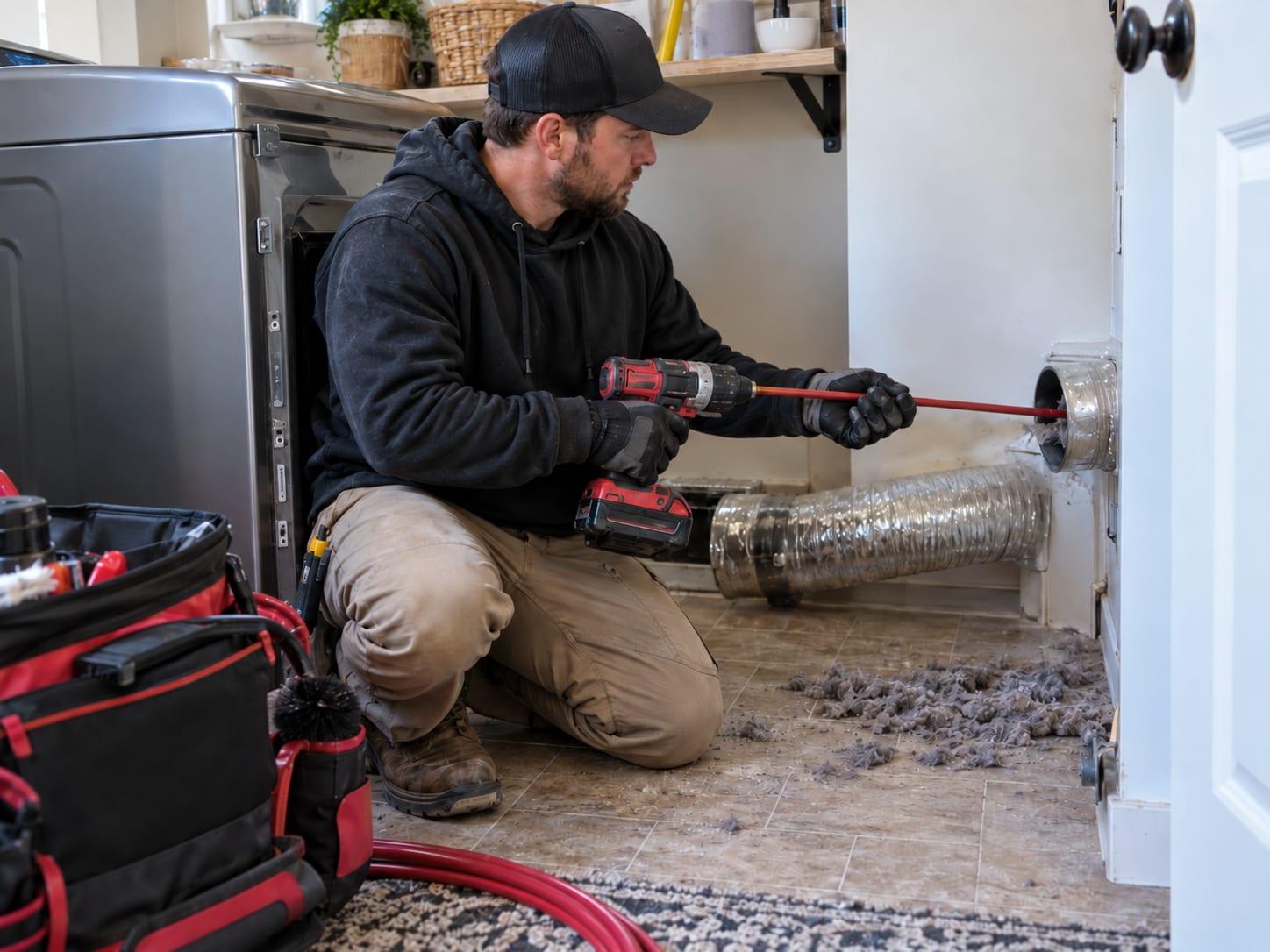
Rerouting means changing the path between the dryer and the exterior: fewer turns, a shorter run or a better wall to exit through. Relocation means moving the vent itself. That might be because the laundry area is moving, a renovation closed off the old route, or the old vent ends somewhere it shouldn't, such as an attic, a crawlspace or a porch ceiling.
Signs your dryer vent needs a New route
Common reasons homeowners ask for rerouting
- Clothes need two or more cycles to dry, even after the vent has been cleaned.
- The vent run is long, with several elbows, and lint keeps coming back quickly.
- The duct ends in an attic, crawlspace, garage or soffit instead of an exterior hood.
- The dryer has to sit far from the wall because the duct behind it is kinked or crushed.
- Flexible foil or plastic duct runs through walls, floors or ceilings.
- A remodel or a new laundry location means the old vent no longer lines up.
- The exterior hood is hard to reach, damaged or stays blocked by birds or debris.
Not every slow dryer needs a new route. If the run is reasonable and simply packed with lint, dryer vent cleaning is the right job. If something is lodged in the line, such as a nest or a wad of lint at a bend, clearing a clogged dryer vent fixes it. If the route is fine but sections are torn, disconnected or the wrong material, fixing or replacing damaged vent sections usually makes more sense than moving it.
What the visit involves, step by step
From the current vent to the new route
Trace the existing vent
We follow the duct from the back of the dryer to where it exits. We note its length, the number of bends, the duct material and the condition of the exterior hood.
Plan the new path
We look for the shortest practical route to an outside wall or roof, with as few elbows as possible. We check it against the length your dryer's manufacturer allows.
Walk you through the options
Before any cutting, you'll know where the new exit will be, what will be opened up and what happens to the old opening.
Remove the old duct
Old sections are taken out where they can be reached. Openings that are no longer used are closed off.
Install the new run
Rigid metal duct goes through walls and ceilings. Joints are sealed with foil tape rather than screws that poke into the airflow and catch lint.
Fit the exterior hood
A hood with a working damper flap keeps out weather and pests without trapping lint behind a fine screen.
Reconnect and check airflow
We reconnect the dryer, run it and check that air moves freely out of the new termination.
Duct materials and where a vent should end
| Feature | Rigid or semi-rigid metal | Flexible foil or plastic |
|---|---|---|
| Inside walls and ceilings | Suitable | Not suitable |
| Interior surface | Smooth, so less lint catches | Ribbed, so it traps lint |
| Resistance to crushing | Holds its shape | Kinks and flattens easily |
| Typical use | The main vent run | Short, visible transition at the dryer, if any |
Inside walls and ceilings
- Rigid or semi-rigid metal
- Suitable
- Flexible foil or plastic
- Not suitable
Interior surface
- Rigid or semi-rigid metal
- Smooth, so less lint catches
- Flexible foil or plastic
- Ribbed, so it traps lint
Resistance to crushing
- Rigid or semi-rigid metal
- Holds its shape
- Flexible foil or plastic
- Kinks and flattens easily
Typical use
- Rigid or semi-rigid metal
- The main vent run
- Flexible foil or plastic
- Short, visible transition at the dryer, if any
A dryer vent should always end outdoors. Venting into an attic, crawlspace or garage puts moisture and lint into the house structure. If you have a gas dryer, it also puts combustion byproducts there.
Safety and upkeep after rerouting
Lint is flammable
Lint that collects in a long or crushed duct sits right next to the dryer's heat source. A shorter, smoother route collects less of it. No vent stays clean forever, though.
- Clean the lint screen before every load.
- Leave enough room behind the dryer so the connector isn't pinched when the machine is pushed back.
- Check the outside hood now and then to make sure the flap opens when the dryer runs and closes when it stops.
- If drying times start creeping up again, have the vent looked at before it becomes a blockage.
Booking dryer vent rerouting & relocation
Get in touch to describe where your dryer sits, where the vent exits now and any changes you're planning. Commercial and property-manager work is offered as well, for buildings with more than one laundry space.